About the game
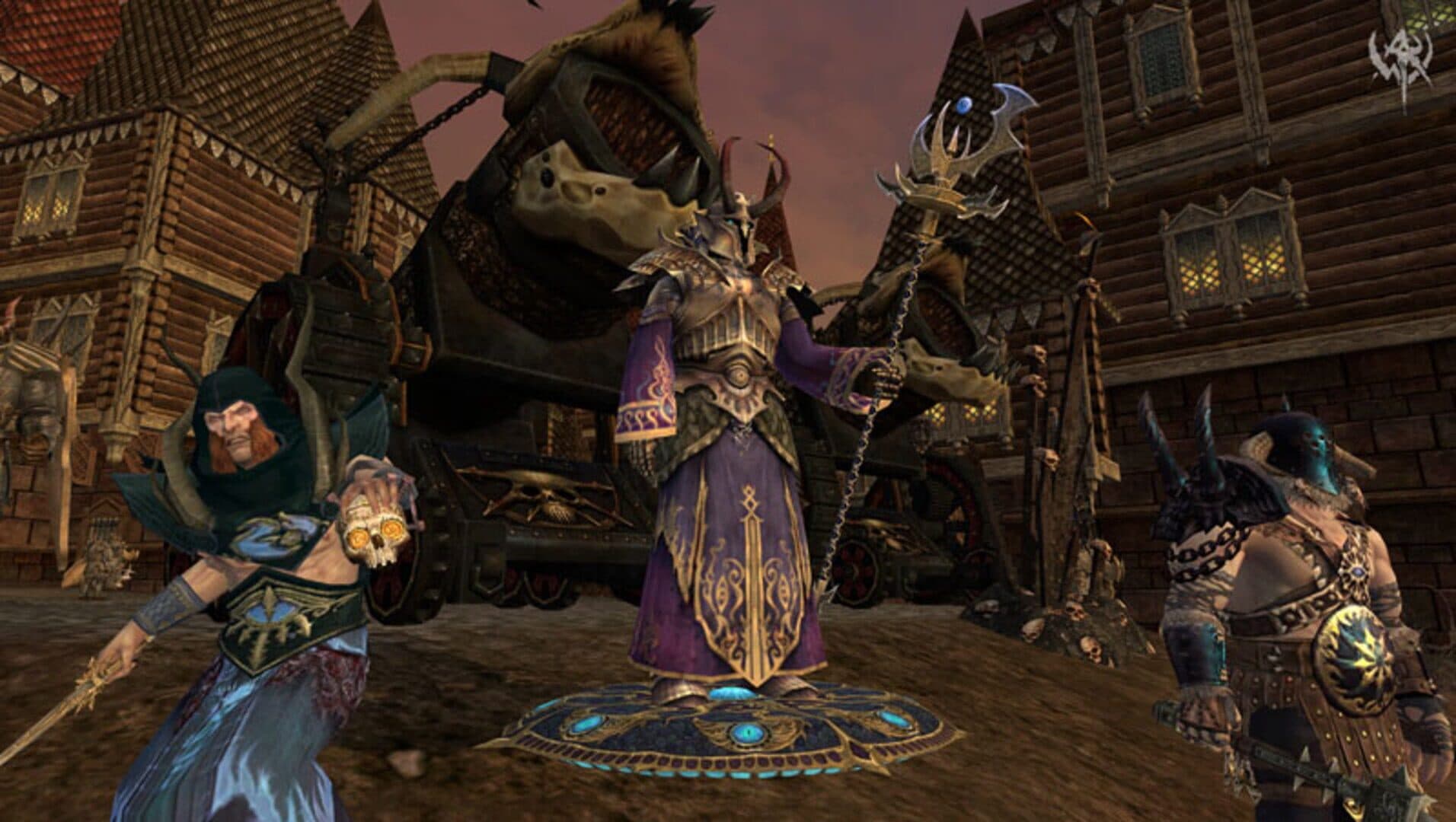
Warhammer Online: Age of Reckoning was Mythic Entertainment's attempt to turn Warhammer Fantasy into a permanent war between Order and Destruction. PvP wasn't a side mode bolted onto a levelling game — the whole thing was built on RvR (Realm vs Realm), with three racial fronts (Dwarfs against Greenskins, the Empire against Chaos, High Elves against Dark Elves) fighting over zones, keeps and, at the end of the line, the sacking of the enemy capital. It launched in September 2008 and became the most credible challenger World of Warcraft ever faced at the time. Its official servers have been dark for over a decade, and people still play it anyway.
War as the backbone
The world was carved into level-banded RvR lakes, and everything that happened there fed a shared campaign: capturing battlefield objectives, sieging and defending keeps with rams and boiling oil, pushing the front until the enemy city opened up for an assault. Running alongside it were Scenarios, short instanced maps that acted as a pressure valve — a way into a fight without waiting for a warband to assemble. The upshot is that in Warhammer Online roles genuinely matter: a tank holding a doorway and a healer who stays alive are worth more than a DPS with pretty numbers, and twenty organised players will break forty who showed up on their own.
24 careers, Public Quests and the Tome of Knowledge
There are 24 careers across four archetypes (tank, melee DPS, ranged DPS and healer), mirrored between the realms but never identical: a Chosen doesn't play like a Knight of the Blazing Sun even though they fill the same slot. Outside PvP, the Public Quests scattered across the open world were one of the game's most widely copied ideas — anyone passing through joins in, the event advances in stages, and loot is rolled out according to how much you contributed. Above all of it sat the Tome of Knowledge, a compendium that logged lore, creatures, titles, tactics and achievements as you played, and which for a lot of players became as strong a reason to explore as the campaign itself.
From WoW's rival to the 2013 shutdown
The launch was huge: 1.2 million copies sold and around 800,000 registered users. The collapse was just as fast. Within months the base bled down to a little over 300,000 subscribers, dragged by performance problems in the big fights, cities that almost never fell, and PvE that never came close to matching the PvP. There were attempts to right the ship — a live expansion with new content in 2009, a smaller free-to-play spin-off — but neither bent the curve. Electronic Arts shut the servers down on December 18, 2013, when the Games Workshop licence expired. There has been no relaunch and no announcement of one since: the store page still sitting on Steam is a leftover that sells nothing.
How to play it today: Return of Reckoning
What keeps the game alive is Return of Reckoning, a community server running since 2014 that reimplemented the network protocol from scratch — it uses no original server code — and has kept it going with a real patch cadence and a public test server. This isn't a museum piece: big patches still land, rebalancing ranged damage across half a dozen careers at once, rebuilding entire Scenarios around new objectives, adding their own progression currency, hundreds of new weapons on vendors and live events written around the lore. You download the project's launcher, make an account and you're in; you don't need to own the original game, which you couldn't buy anyway.
The flip side is the population, and it's worth saying plainly: there is a single server, and it typically sits between 250 and 550 concurrent players against a 3,500 capacity. The Order/Destruction balance is reasonably even, and the mid and high-tier lakes were merged precisely so people run into each other instead of scattering. At peak hours the mass fights the game exists for do happen; off-peak, it's a considerably quieter experience.
What it costs
In its official life it ran the classic 2008 model: buy the box, then pay a monthly subscription of around fifteen dollars, with three- and six-month discounts and no item shop worth mentioning. Late on, EA added an unlimited free trial that let you reach rank 10 with restrictions. None of that exists now: there is no legal way to buy or subscribe to the game. Return of Reckoning is free by explicit policy — no shop, nothing sold that affects play, and it doesn't even accept donations, specifically to stay clear of Games Workshop's intellectual property. Everything is open from minute one, with no account tiers and no passes.
Who it's for (and who it isn't)
Warhammer Online still makes sense for anyone after objective-driven mass PvP rather than arenas: dozens of players fighting over a keep, where the tank and the healer decide the outcome and organisation beats gear. It also rewards anyone curious to see first-hand where ideas half a dozen later MMORPGs recycled actually came from. Almost everything else argues against it: this is a 2008 game and it shows in the visuals, the interface and the frame rate once the screen fills up; PvE was always its weak half; the population is enough for fights but nowhere near the 2008 feeling; and the project keeping it running sits in a tolerated legal grey zone — never targeted by Games Workshop or EA, but never blessed either — so its future isn't guaranteed. With all that on the table, it's a free, open door to a kind of war almost no MMORPG has tried since.
Screenshots
Videos
Community reviews
Nobody has reviewed this game yet. You can be the first.
Related news
0Similar games
 Mortal Online 2MMORPG · Fantasy · B2P+SUBLive
 Final Fantasy XIV Online9.0MMORPG · Fantasy · B2P+SUBLive
 Monsters & MemoriesMMORPG · Fantasy · SUBIn development
 Elden Ring9.7Souls-like · Dark fantasy · B2PLive
 Broken RanksMMORPG · Dark fantasy · F2PLive
 Star Wars Galaxies: An Empire DividedMMORPG · Sci-fi · B2P+SUBShut down