The Seven Deadly Sins: Origin
About the game
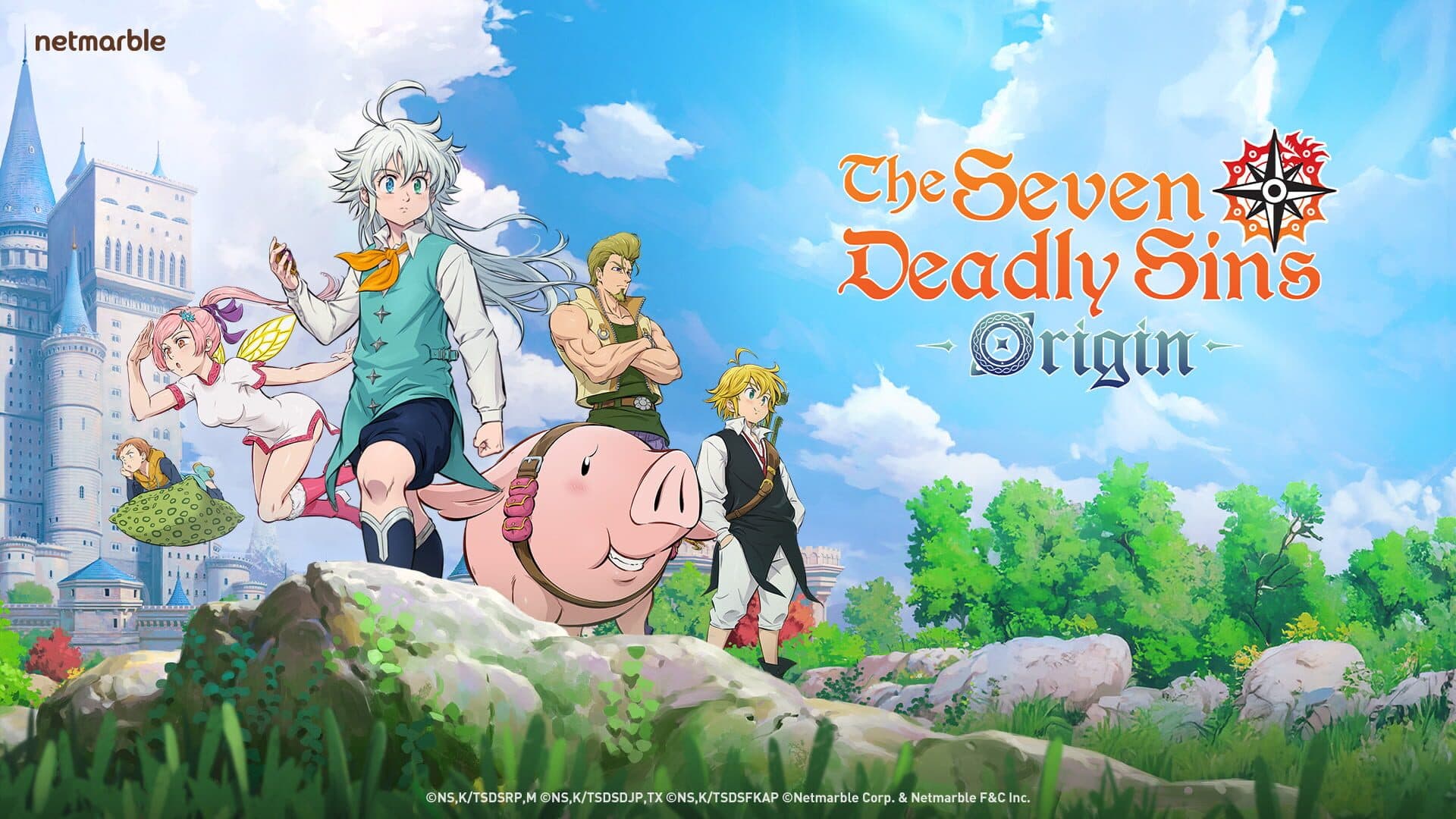
The Seven Deadly Sins: Origin is Nakaba Suzuki's franchise going open-world. Built by Netmarble F&C on Unreal Engine 5, it puts you in the boots of Prince Tristan of Liones and turns you loose on a seamless Britannia that carries the anime's look intact. The story doesn't adapt the manga: it's original to the game — a collision of time and space that folds dimensions together — and it mostly exists to put the Seven Deadly Sins cast and the Four Knights of the Apocalypse cast on the same roster, voiced by the anime actors. It launched March 16, 2026 on PC and PS5, with iOS and Android a week later; progress carries across platforms, and you can dig into the details on the official site or on Steam.
Four-hero teams, and weapons that decide the role
Combat runs on four-hero teams that swap in and out in real time, and the whole point is chaining that swap into your combos and elemental link effects — big damage almost never comes from one character alone. Origin's own wrinkle is the weapon. The same hero works as a tank, a damage dealer or a support depending on what they're holding, so how you build a team matters as much as who you've pulled, and a character who'd be a bench-warmer elsewhere can start here with the right kit. Heroes come from gacha; weapons don't.
How much MMO is actually here
It isn't a traditional MMORPG, but it isn't a single-player RPG with a chat box bolted on either. The main city acts as a social hub where you bump into other players, and there are guilds, world bosses, dungeons and four-player co-op raids, plus hunting events that pull in as many as fifteen. Everything else — exploring, fishing, cooking, puzzles, pushing the campaign — is yours alone. If you want a persistent world with crowds and a shared economy, this isn't it; if you're coming from other open-world gacha games, the co-op layer is noticeably more generous than the norm.
What you pay for, and what you don't
The game is free to play, and hero gacha is the engine. The featured banner guarantees an SSR every 80 pulls and the promoted character by 120, with a 50/50 in between — and one thing worth knowing before you hoard: pity doesn't carry between banners, so saving pulls "just in case" buys you nothing. In its favour: there's no weapon gacha (weapon skins are purely cosmetic), and duplicate copies feed constellations, six for the cap. Against it: the storefront. Season passes, a premium battle pass around $4.99, subscriptions, gem packs, shard shops, crystal shops, several parallel currencies. You can clear the campaign and the co-op content without spending a cent, but free currency accrues far too slowly to keep pace with paying players, and Netmarble runs its usual playbook here: generous for the first few weeks, with the squeeze arriving later.
Where it stands: support, population and reception
Origin is live and actively supported, on a steady cadence of roughly one version every three weeks: a new playable character, another act of the main story, a region added to the map, limited-time events, and quality-of-life fixes that have trickled in (retrying dungeons and bosses without leaving combat, for one). Commercially it opened big: over $10 million on mobile in its first month against two million downloads — Japan accounted for nearly half of that revenue, followed by Korea, the US and France — and it cracked the global top 6 by revenue on Steam during launch week.
The picture today is cooler. On PC it went from a peak of 65,753 concurrent players on launch day to hovering around five and a half thousand — though the decline has flattened out, and the bulk of the player base is on mobile, so the Steam figure never told the whole story. Reception landed lukewarm: 58% positive lifetime reviews on Steam — "Mixed" — with recent reviews a bit healthier at around 67%, and no aggregate Metacritic score yet. The complaint is always the same, and it's technical: engine optimisation, stutter, input lag and crashes on mid-range phones, plus a cluttered UI and uneven animation work. Patches have been chipping away at it with visible results, but it's still the first thing any review brings up.
Who it's for (and who it isn't)
It's an easy recommendation if you're a fan of the series — the crossover roster, the original voice cast and a Britannia you can actually walk through do a lot of the heavy lifting — or if you like gacha action RPGs and want one where team-building carries more weight than raw luck, thanks to the weapon system. Likewise if you want a gacha with real co-op: four-player raids and fifteen-player hunts aren't common in this genre. Think twice if your PC or phone is on the low end, if what you actually want is an MMORPG with a persistent world and a shared economy, or if wading through shops and currencies wears you out — the business layer is the heaviest part of the package. Origin is an anime game that's generous with content and solid in combat, with a ceiling it hasn't reached yet because of technical rough edges and a monetisation model that asks a lot of patience from anyone who doesn't spend.
Screenshots
Artworks
Videos
Community reviews
Nobody has reviewed this game yet. You can be the first.