Open-world survival action MMO
Dune: Awakening
Funcom (con NUKKLEAR) · Sci-fi
StatusLive
ModelB2P
SpanishSubtitles, no voice acting
Platforms
Critics' score8.9
About the game
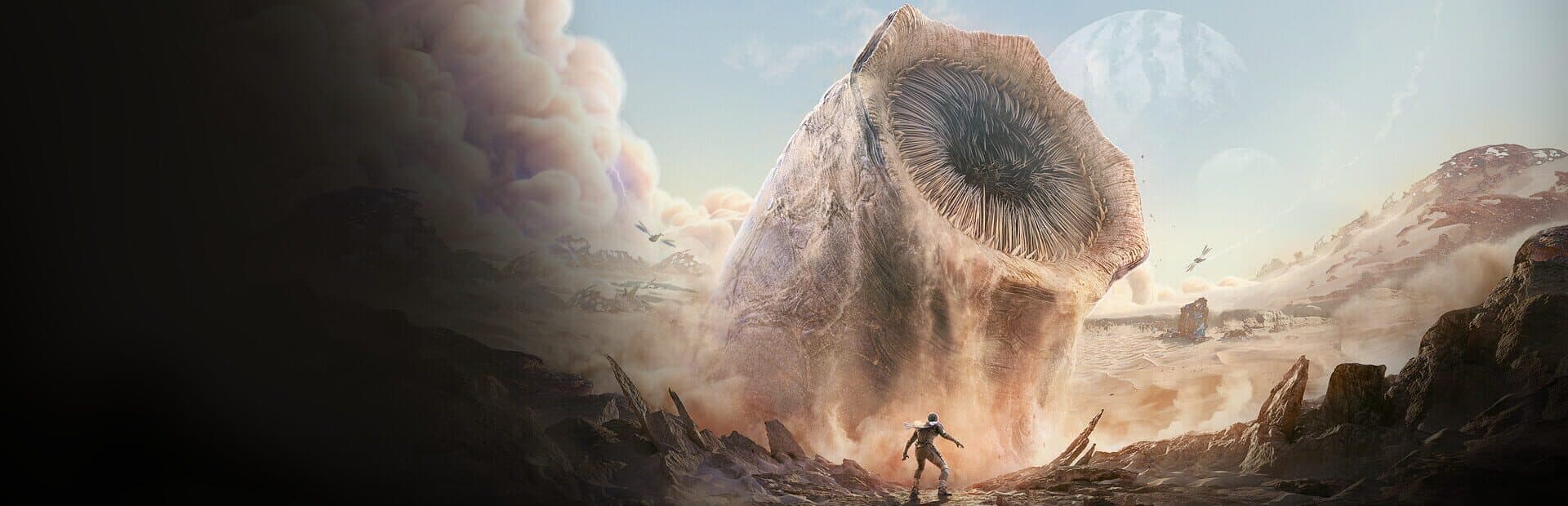
Dune: Awakening is an open-world survival action MMO set on Arrakis, developed and published by Funcom. The first thing worth knowing is that it isn't a faithful adaptation — it breaks from the novel on purpose. In this timeline Paul Atreides was never born, the prophecy collapses before it begins, and the planet is left as an open board where houses, guilds and newcomers fight over the spice. That gap in the canon is the license the game gives itself to write you into the story.
You start at the very bottom, and the desert makes sure you notice. At character creation you pick one of five schools —Mentat, Bene Gesserit, Swordmaster, Trooper or Planetologist— which define your abilities and how you fight, and then you're dropped into a world where the sun kills faster than any enemy. The first hours are water, shade and your stillsuit: wringing moisture out of every corpse, working out where the shade will fall an hour from now, and never crossing open sand at a steady rhythm unless you want a worm to come find you. Combat mixes Holtzman shields —which stop the fast and let through the slow, just like the book— with ranged weapons and melee.
That tension never goes away — it just changes scale. Over time you build modular bases that need power and water, you fly ornithopters that turn a map which used to kill you into something you can actually cross, and you go from scraping spice by hand to running industrial harvesting operations. There's a real MMO layer around all of it: cities like Arrakeen and Harko Village act as social hubs with player trading, contracts and actual crowds, while the open world runs on shared servers.
The Deep Desert and the Landsraad
What separates Dune: Awakening from the rest of the survival pack is what happens once you leave the safe zone. The Deep Desert is the endgame region, and the Coriolis storms rebuild it from scratch every week: the map changes, high-tier resources get redistributed, and anything you built out there is gone. It's expedition territory, not a place to move into. Since the PvE pivot it exists in two flavours —a PvE-only version and a PvP one with a resource multiplier— so whether another player gets to ruin your run is your call.
The other pillar is the Landsraad, a weekly political cycle with no clear equivalent in the genre. You align with House Harkonnen or House Atreides and push the resolutions your house puts on the table by handing in materials; whatever wins the vote binds the entire server for the week, from economic perks to rules that change how the game plays. It's collective meta-game: your own contribution is a drop, but you feel the outcome either way.
What you pay for, and what you don't
The model is buy to play, no subscription. You pay once —US$49.99 for the standard edition on Steam, US$69.99 for the Deluxe and US$89.99 for the Ultimate, the last two bundling the Season Pass— and the whole game is yours. The Season Pass sells separately for US$24.99 and covers four DLC packs that are, in practice, cosmetics and building pieces: wildlife, imperial stations and a vehicle, hundreds of decorative parts and variants, an ornithopter, emotes. There's no monthly fee, no battle pass and no premium currency, and Funcom publicly committed to DLC never granting a competitive edge or higher-tier gear, and to content updates —the Chapters— staying free for everyone. On Xbox it lands day one on Game Pass Ultimate and PC Game Pass, with Xbox Play Anywhere support.
Where the game stands
The game is live and actively developed. The cadence is a free Chapter roughly every three months, paired with a Season Pass DLC and backed by patches in between; on that rhythm came specializations, the Landsraad revamp, faction ranks, the end of the imperial tax on bases, and new locations on the map. The big structural change was the PvE-first pivot: Funcom found that over 80% of its players only did PvE, split the Deep Desert into separate instances, removed the PvP zones from Hagga Basin on official servers, and enabled self-hosted private servers, still experimental and with awkward requirements (Windows Pro with Hyper-V). Fighting other players is no longer required to progress.
The numbers tell the familiar story of a huge launch settling down: a million copies in 18 days —Funcom's fastest-selling release in three decades— and a Steam peak north of 189,000 concurrent players, against the few thousand it holds as of mid-2026, sliding month over month. It's a small but functional population. The next big milestone is September 22, 2026: the PS5 and Xbox Series X|S launch and, the same day and free on PC, a full offline single-player mode with adjustable difficulty, plus the closing chapter of Book One. The roadmap leaves the door open to a first expansion.
Who it's for (and who it isn't)
If you like survival crafting games and Dune interests you even a little, this is probably the best place that crossover exists right now: the setting isn't a skin, it's wired into the mechanics —water, shade, the rhythm of your footsteps, spice as an economy— and the Deep Desert and the Landsraad give it an endgame with a texture most survival games never find. The single-player mode also makes it a reasonable pick if you want the story with nobody else around. More details and patch notes live on the official site.
The bad, plainly: it's a grindy game, and its middle stretch —between the pure-survival opening hours and the endgame— sags into repetitive gathering that loses a lot of people. The shrinking population means the social side depends on your timezone and your server, and that PvP areas are noticeably emptier than they were. Private servers are still experimental. And the main story hasn't closed its first book yet. Dune: Awakening is a solid, well-supported game, but go in knowing it asks for a good number of hours before it hands back the best of what it has.
Screenshots
Artworks
Videos
Community reviews
A few more reviews and we'll publish the averageso far: 0 of 5
Nobody has reviewed this game yet. You can be the first.