About the game
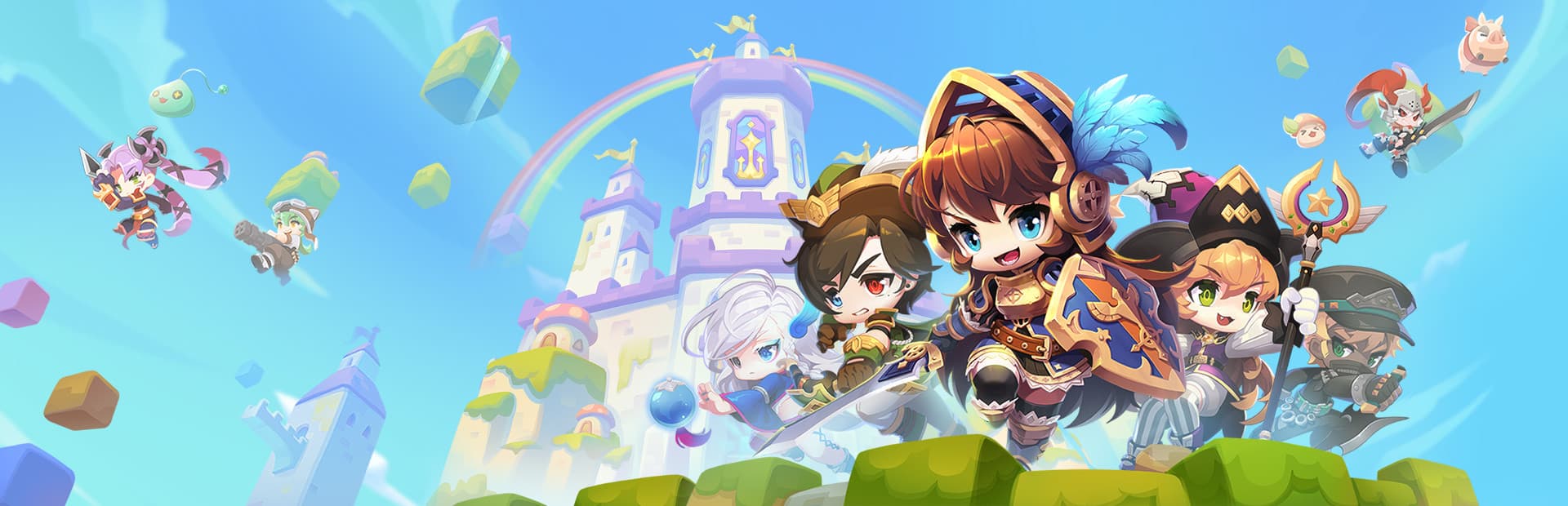
MapleStory 2 was Nexon's attempt to move the MapleStory universe into three dimensions: a world built out of blocks, an isometric camera, and a chibi look so bright you could recognize it from a single screenshot. It launched in Korea in July 2015 and reached the West in October 2018. There is no official version left standing today, but for those years it was one of the oddest and most charming MMORPGs in the free-to-play catalog.
A fairly classic MMORPG under the toy
The look was deceiving: underneath sat a textbook MMORPG. Nine classes with distinct identities, co-op dungeons, bosses that telegraphed their attacks by painting them on the floor, and a level 60 cap you could reach without suffering. Combat was accessible and readable rather than demanding, built on that "step out of the red circle" spatial logic anyone gets during their first raid. It worked, but it was never the reason people stayed.
Half the game happened outside combat
That is where it stood apart. Houses were raised block by block, with an editor the community pushed to ridiculous extremes. A design workshop let anyone draw their own outfits and sell them to other players. And around all of that there was no shortage of things to do: fishing, mass minigames, instruments you actually played note by note, platforming exploration, and even a 50-player battle royale mode. MapleStory 2 was, above all, a social and creative MMO with an MMORPG inside it, not the other way around.
What you paid for and what you didn't
It was free to play with no mandatory subscription. The premium currency was the Meret, in two flavors: the blue one was bought with real money (100 Meret ≈ 1 USD) and the red one was earned by playing and covered almost the same ground. There was a convenience pass, the Premium Club, at around 490 Meret a month —roughly 5 USD— with experience bonuses, storage and quality-of-life perks. The key point: the Western shop was almost entirely cosmetic and sold no combat power, unlike the Korean version, which did offer items that affected gameplay. Style crates cost 300 Meret with published odds (100 possible outfits, 1% each), and duplicates were recycled into tokens you could trade for other cosmetics. None of it can be bought today: Nexon stopped selling Meret months before the shutdown and refunded purchases made from December 2019 onward.
Current status: shut down in every region
There is no official way to play it. The global and Japanese servers closed on May 27, 2020 —Japan less than a year after opening— China ended in November 2022, and Korea, the last one standing, closed on May 29, 2025 after nearly ten years of service. Nexon's explanation never changed: it could not sustain a service that met expectations. The game is delisted from Steam, there is no official client to download, no patches and no roadmap, and players were pointed toward the original MapleStory and MapleStory Worlds.
Who it was for, and what's left today
It was for anyone after a light, social, creative MMO: people who enjoy decorating a house, designing outfits, goofing around in a minigame with friends and leveling up in between. It was never for players who want deep systems or an endgame that holds up for years, and that was precisely its Achilles heel: max-level content ran dry fast, the global population collapsed within months, and the rest is well-known history.
The only thing still alive is the scene of reverse-engineered private servers and emulators, with partial content, uneven stability and manual installation: good for poking around or revisiting a world you were fond of, not for starting an MMO in earnest. If you never played it, today it is more a museum piece than a recommendation; if you did, you already know there is no exact replacement out there.
Screenshots
Videos
Community reviews
Nobody has reviewed this game yet. You can be the first.