Habbo
About the game
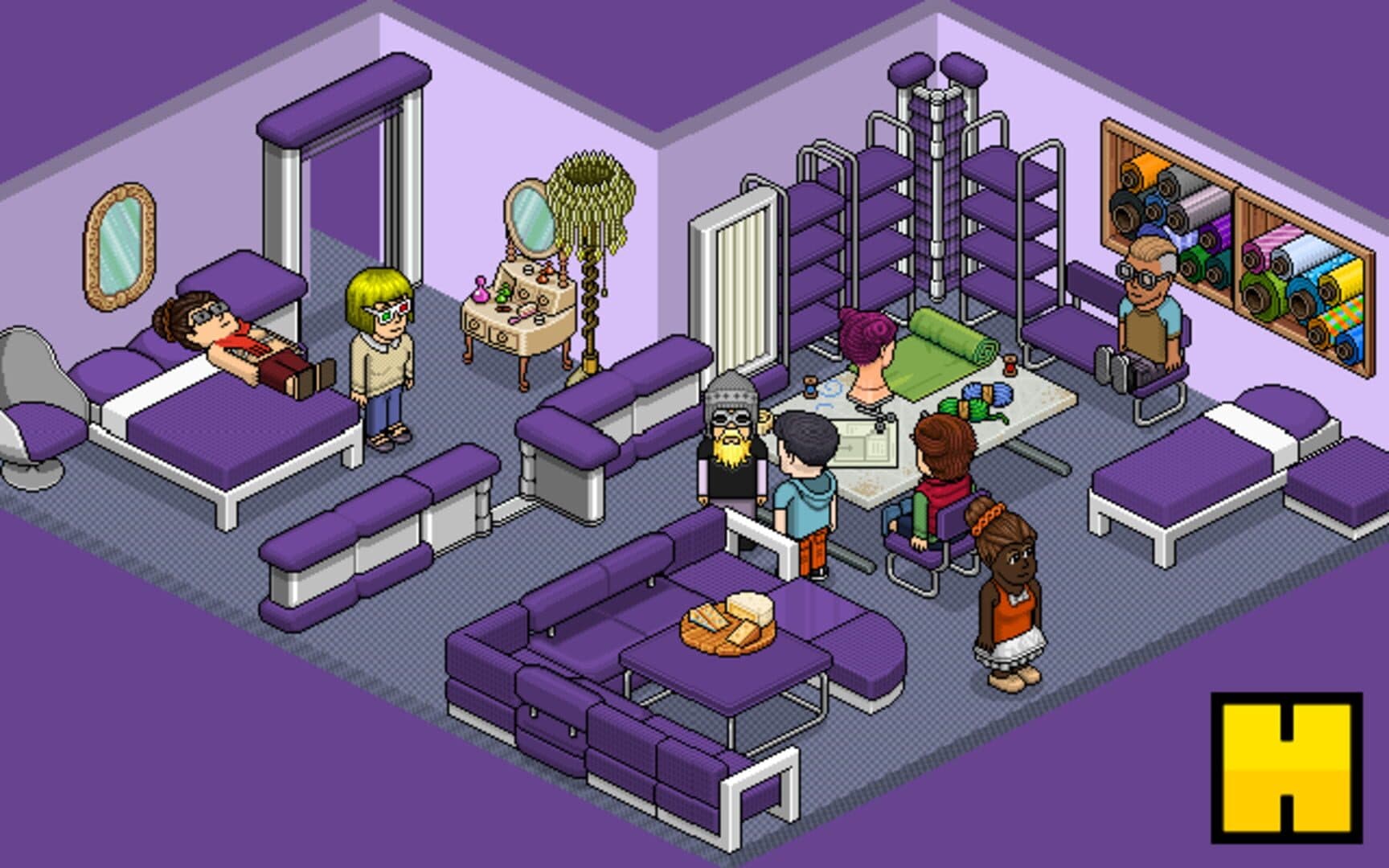
Habbo is a pixel-art social world that opened in 2000 and never shut its doors. The metaphor is a hotel: you build an avatar, walk into a lobby and step from there into rooms other players built, or rent your own and furnish it tile by tile. There are no levels, no quests, no bosses — nothing to complete. The only thing giving the experience shape is whoever else happens to be online at the same time as you, which is both its greatest strength and its biggest gamble.
Everything worth doing was invented by the players
Sulake supplies the walls and the furniture; the people supply the content. At any given hour there are roleplay rooms running their own rulebooks — hospitals, prisons, whole cities with a working police force — plus homebrew casinos, radio shows with live hosts, decorating contests, and minigames built with WIRED, a block-based logic system that lets you script behaviour inside a room without writing a line of code. That's where the 120-million-plus user-made rooms in its history came from. Habbo is, underneath it all, a social construction toy dressed up as a hotel.
On top of that runs a barter economy that is half the soul of the game. Rare furniture and limited editions work as status currency: a sofa discontinued ten years ago carries more weight in a negotiation than any character stat ever could, and there's an in-game Marketplace for reselling between players. Learning what's worth what is, for a lot of people, the hotel's real progression system.
What you pay for and what you don't
Habbo is free to play with no gate: a free account gets you the whole thing in the browser or on the Android and iOS apps. Above that sit three currencies. Credits are bought with real money and are the catalogue's main currency; diamonds come as a gift with every credit purchase (one per credit) and unlock premium items; duckets are earned for free through achievements and activity. The Habbo Club subscription runs around 50 credits plus 50 diamonds a month and adds exclusive clothing and furniture, along with a "Pay Day" on the 15th that refunds credits based on your subscription streak. The Builders Club is a second subscription aimed at people who build, raising room and size limits. None of it is required to play — what you're buying is decoration, status and convenience — though it's worth knowing there's also a separate collectibles layer with NFTs that stayed a side branch and never touched the day-to-day hotel.
The state of the hotel today
The game is live and actively developed. It turned 25 in 2025 with a month of events and loyalty crowns for the oldest accounts, and Sulake — now part of Azerion — keeps it running across nine language communities, Spanish among them, on a Unity client that works in the browser and on Windows, macOS, Android and iOS. The 2026 roadmap is titled Fixing the Foundations and is openly a repair plan rather than a feature plan: stabilise the Unity client and the mobile experience, redesign the Marketplace, add the Habbicons collection and overhaul the Navigator (that last one already shipped). Several long-standing frictions went with it: trading barriers and Marketplace price caps were removed, and the game added anti-scam warnings for lookalike usernames, stronger bot defences and changes to moderation and age verification. The flip side is that no active-player numbers are published: the community is loyal and steady, but far smaller than at its 2000s peak.
Since 2024 the modern hotel shares the stage with Habbo Hotel: Origins, a deliberate rollback to the 2005 client for players who'd rather have the version without twenty years of layers piled on top. It started on its own launcher and, since October 2025, is also on Steam, free to play with the same in-game purchases. Go in with measured expectations: reviews there are split and concurrency settled well below its launch-day peak. It's a branch for the nostalgic and for anyone wanting a simpler hotel, not a mass relaunch.
Who it's for (and who it isn't)
Habbo works if what you want is to talk, to build and to belong somewhere: you'll have a good time assembling rooms, haggling over furniture, joining someone else's roleplay or inventing a WIRED game for strangers to try. It's also one of the few social MMOs with a real, sustained Spanish-speaking community, which counts for a lot. It doesn't work if you expect progression, combat or clear objectives: there's no power curve and no weekly content served up by the studio, and if you log in at a quiet hour you may find a half-empty hotel.
The bad parts deserve to be said in full. The modern client is buggy and that's the community's loudest complaint — enough that the studio built its whole year around fixing it. Scammers are around, and while the new warnings help, your own suspicion is still the real defence. And the rare-furniture economy can turn into a money pit if you take it seriously. Getting in costs nothing, and that's the best way to judge it: if half an hour later you're chatting away in some strange room, the hotel is still doing its job.
Screenshots
Videos
Community reviews
Nobody has reviewed this game yet. You can be the first.