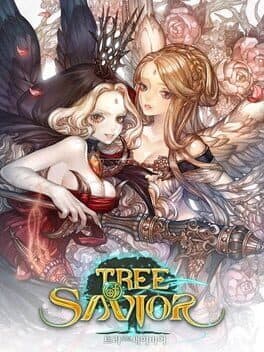
Tree of Savior
About the game
Tree of Savior is a Korean free-to-play MMORPG developed by imcGames, the studio of Kim Hakkyu, the mind behind Ragnarok Online. That heritage shows in every corner: grind-driven progression, hand-painted anime visuals, and a huge soundtrack scored in part by the same team. Its world leans on Baltic and Lithuanian mythology: four years after a cataclysm called Medzio Diena, the goddesses have vanished, and your character follows a revelation left by Laima, the goddess of fate. It's a classic, dense MMO with a personality of its own—closer to old-school design than to slick, accessible modern action.
What sets it apart: the class system
The heart of Tree of Savior is build freedom. You start from one of five base classes—Swordsman, Wizard, Cleric, Archer, or Scout—and branch through dozens of advanced classes, mixing them to shape builds that are hard to replicate. That depth is its biggest draw and also its learning curve: figuring out which combinations work is part of the game. In return it asks for patience. Leveling is fairly linear, and grinding—for levels, gear, and silver—is the core loop. Players who enjoy tuning a character piece by piece will find plenty to chew on here; those after quick gratification probably won't.
Business model: what you pay for and what you don't
The game is free and downloads at no cost from its Steam page; there's no mandatory subscription. Monetization revolves around the TP shop, whose currency you buy with real money (around 9 USD per 100 TP) and spend mostly on cosmetics, beauty services, consumables, and premium conveniences. On top of that you earn 1 free TP every 4 hours up to a cap of 5, enough for small consumables like megaphones or warp scrolls. The key piece is the Token: the first one is bought with real money and unlocks player-to-player trading and premium perks, but afterward you can get more Tokens using in-game silver. That detail softens—without fully erasing—the pay-to-win criticism the game carries.
Current status: alive, but niche
Launched in 2016, Tree of Savior is still live and being patched in 2026, with regular fixes and tweaks from imcGames. The international version is published by Papaya Play. The flip side is its size: the population is small and niche—on the order of a couple hundred concurrent players on Steam—and reviews there are 'Mixed' (around 64% positive across 20,000-plus). The long-term future of the original MMO is a bit uncertain: in 2025 imcGames announced Tree of Savior: Neo, an all-new version for PC and mobile, having already released mobile spin-offs before. There's no clear public roadmap beyond seasons and one-off events, so today it reads more as a classic that keeps running than a game in full expansion.
Who is it for?
Tree of Savior is for players who want a classic, dense, nostalgic MMO, with a depth of customization few can match and a charming art direction. If you enjoy grinding with a purpose, theorizing builds, and getting lost in a world with dark-fairytale aesthetics, there are years of content waiting. Being honest means naming what it doesn't offer too: a small community, tutorials that don't always help, slow and linear progression, and the pay-to-win shadow surrounding the Token. If you're after modern action, crowded matchmaking, or a gentle on-ramp, this probably isn't your MMO. But if old-school design calls to you, it's a niche gem that's still standing. You can learn more on its official site.
Screenshots
Artworks
Videos
Community reviews
Nobody has reviewed this game yet. You can be the first.