Ultima Online
About the game
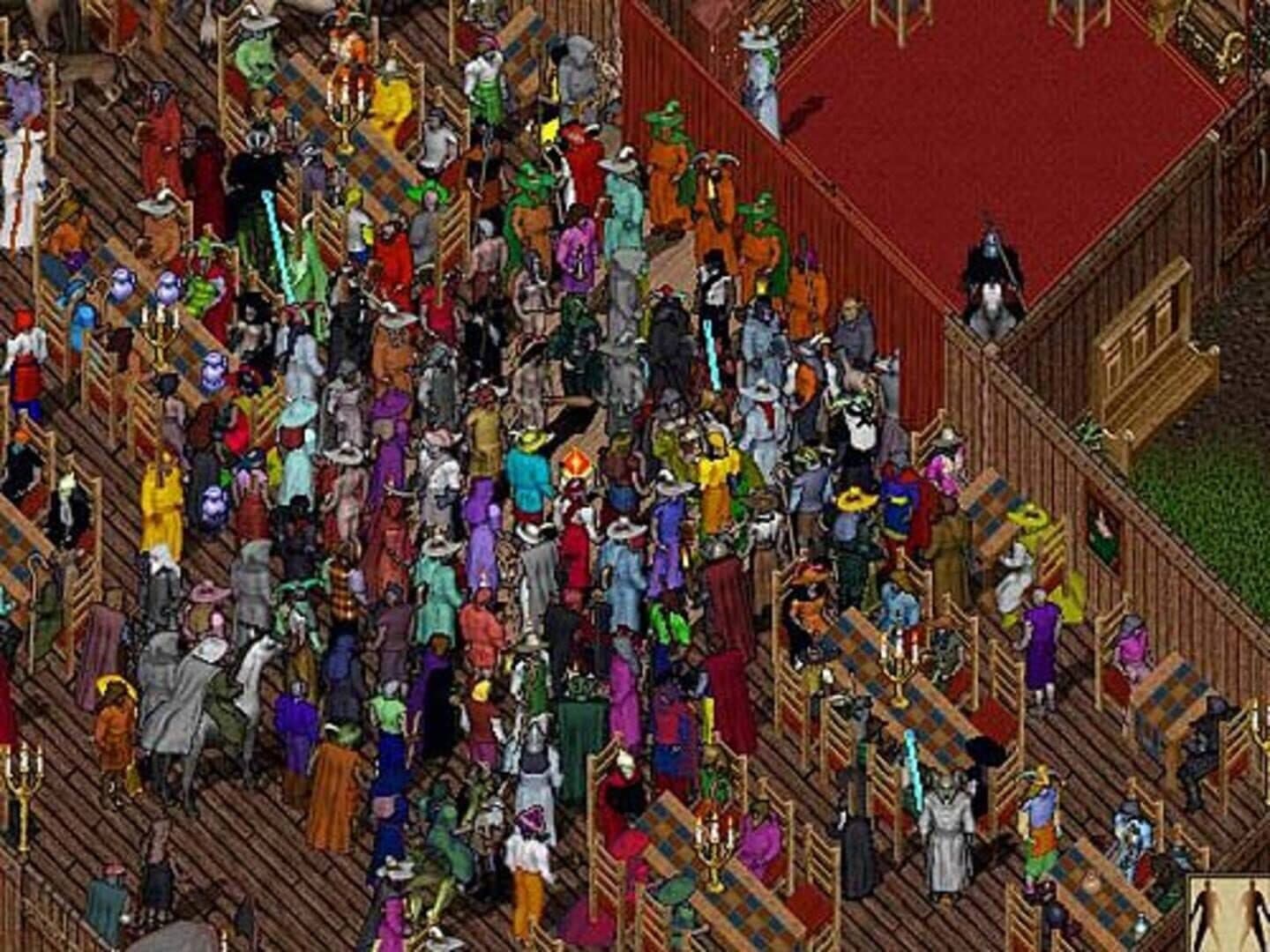
Ultima Online has been running for nearly three decades, and it's still the most stubborn sandbox in the genre. Origin Systems launched it in September 1997, back when nobody was quite sure what an MMORPG even was, and a lot of what we now take for granted — a persistent world shared by thousands, an economy propped up by players, houses you actually own, PvP with real consequences — was tried here first. You play it in an isometric view over Britannia, the world of the Ultima series, and it's maintained today by Broadsword Online Games under the Electronic Arts umbrella.
A world with no classes and no levels
There's no class to pick and no experience bar to watch. You have skills — swordsmanship, magery, blacksmithing, tailoring, taming, stealing, fishing — that grow as you use them, under a global point cap that forces a choice: if one goes up, another has to give ground. Your character becomes the sum of what you practice rather than a prefab archetype, which is why so much community talk revolves around templates: skill combinations built for a specific role, argued over and refined for years. The flip side is that the game never takes your hand. There's no campaign nudging you from zone to zone, just an open world where deciding who you want to be is your problem.
The other signature feature is the house. You don't buy it from a menu and it doesn't live in an instance: you place it on a free patch of land in the shared world, and if nobody left room, you don't get one. Half the game orbits that plot — decorating it, storing things in it, hiring vendors who sell your goods while you're logged off. Crafting has real depth (region-specific resources, variable quality, gear that breaks), which is why the economy is genuinely player-run: somebody mines, somebody smiths, somebody sells, and the market sets the price, not an NPC.
The world is mirrored across facets with different rulesets. On the protected ones nobody can attack you without consent and you're free to do your own thing; on the open ones anyone can rob you, kill you and walk off with what you were carrying, with a notoriety system that brands murderers. And that's where the best rewards live: doubled resources, champion spawns, and loot worth the risk. It's old-school PvP with material loss and reputation on the line, and it's one of the few things the modern genre simply stopped offering.
What you pay for, and what you don't
The core model is still a monthly subscription, around USD 12.99, with 1-, 3- and 6-month game time codes sold through the EA store. Check your regional price before committing: local amounts aren't a straight dollar conversion, and in 2026 several markets were hiked sharply — the UK, Germany, Spain and especially Brazil, where the six-month bundle nearly tripled — which did not go down well. On top of the sub, later expansions and packs (High Seas, The King's Collection, Time of Legends, the decorative theme packs) are bought separately.
There's a permanent free tier too: Endless Journey. It never expires, covers content up to the Stygian Abyss expansion, and lets you run quests, collections, virtues and city loyalty — more than enough to find out whether the game clicks. What it cuts is precisely what sustains long-term play: no house ownership, no vendors, a bank capped at roughly two dozen items, gathering limited to basic materials, and no access to veteran rewards, champion spawn rewards or the Justice virtue in PvP. Only one active Endless Journey account is allowed per IP per shard. You can turn a subscription on over that same account whenever you like, and every restriction lifts at once.
Where the game stands today
Alive and in active development, which at this age is no small thing. Broadsword ships publishes several times a year through the official site: Britannia's own seasonal festivals, new boss encounters, PvP balance passes, craftables and item cleanup campaigns. The recent roadmap also points at housing improvements and a PvP overhaul, and the big technical bet is rewriting the Classic Client renderer from software to GPU — a long job, with a public beta and stages that keep stretching, but the first deep modernization of the veteran client in years. There are two clients to choose from, the classic one and the more modern (and busier) Enhanced, and picking one is part of the initiation ritual.
The other leg is New Legacy, a seasonal shard running since 2024 aimed at newcomers and returning players: you start from scratch, with rebuilt onboarding, its own story lines, permanent unlocks that stay with your account, and seasons that reset the cycle. Right now it's the least abrasive way in. On the community side, two things worth knowing: the official forums were shut down and the conversation moved to Discord, and Broadsword has been sanctioning accounts that use unauthorized third-party clients. The population is small and hard to pin down — outside trackers put it in the tens of thousands of active accounts depending on the week — and heavily concentrated: Atlantic is the dominant shard and the de facto market, with Great Lakes, Lake Superior, Catskills, Pacific and Origin trailing behind. If you're going in, picking the right shard matters more than any build decision.
Who it's for (and who it isn't)
Ultima Online is for players who enjoy systems more than spectacle: the kind who get excited about assembling an odd template, running a crafting business, decorating a house for months, or diving into a champion spawn knowing everything they're carrying is at stake. If that sounds good, there's no substitute — no modern MMORPG gives you this mix of freedom and consequence. But let's be honest about the cost of entry. This is a 1997 game and it shows everywhere: clunky interfaces, information that lives in community wikis rather than in the game, a learning curve with no patience for the impatient, and a small, deeply veteran community where the twenty-year regulars are easy to spot. On top of that, you pay a subscription to reach the part that really hooks. If you want visuals, guidance and a clear progression track, look elsewhere. If you want a world that doesn't look after you, this is still the original.
Screenshots
Videos
Community reviews
Nobody has reviewed this game yet. You can be the first.