The Wolves of Mordor: LOTRO's Next Expansion Arrives This Fall With Two Ambitious New Systems
Standing Stone Games details The Lord of the Rings Online's next expansion: an unseen northeastern Mordor, werewolf societies, and two new systems, Neighbors and Survival Instinct, this fall.
The Lord of the Rings Online is returning to Mordor, and this time it does so through Middle-earth's back door. In an interview with Standing Stone Games' Allan "Orion" Maki, the studio revealed The Wolves of Mordor, the veteran MMORPG's next expansion, targeted for this fall (2026) with content rolling out through the end of the year. There's no exact date yet, but there is a clear roadmap: an all-new region, a story that digs into Sauron's darkest past, and two new systems the team wants to keep building on for years.
Sauron, Lord of Wolves
The expansion takes players to northeastern Mordor on the trail of werewolves who fell from Sauron's favor. The narrative hook is a strong one for any Tolkien fan: rather than repeat the formula, the team looks back to the First Age and to the pre-Ring Sauron whom The Silmarillion and Beren and Lúthien describe as the Lord of Wolves. It's lore the game has rarely touched, and it gives the expansion an identity of its own next to previous trips to Mordor.
Those wolves, the Draugardh, aren't generic enemies. Maki describes them with hierarchies and a society of their own: the Gaurhoth, the most powerful, bred by Morgoth and Sauron through necromancy, intelligent and capable of speech and sorcery; the Draugrim, lesser and part-human, semi-bipedal but wolf-like; and the Khurz-hai, Men and Orcs infected with the wolf-sickness who serve as hounds. "They speak, they are both bipedal and quadrupedal, there are hierarchies that are built into them, and they have their own society," the designer sums up.
The Neighbor System: housing that comes alive
The first of the two new systems is an evolution of housing. With the Neighbor System, players can invite NPC neighbors into their homes —one per Free Peoples race— and live alongside them. It's no static ornament: each neighbor has over 100 assignable personality traits across four characteristics, moods that shape interactions, and a friendship system that unlocks story adventures and gift exchanges. The underlying idea is that the player's world pays attention to them: "They will read the journal that you've created and provide feedback on how they feel about that story," Maki explains. There are incentives for daily interaction and plans to tie it into the existing festival systems.
The one thing to watch is access: for now the Neighbor System is tied to pre-order bonuses, and the studio hasn't yet clarified how it will be available after launch. It's the kind of detail worth seeing confirmed before drawing conclusions.
Survival Instinct: end-game progression without raising the cap
The second system aims squarely at the end-game. Survival Instinct is an account-wide progression —not per character— built for the expansion's regions, with three new skills per faction, nine tactics, and sixteen enhancements. Each faction plays differently: the Woses lean into physical combat, while the Têtikir favor tactical, defensive options. One example skill, "Hopeful Healing," applies hope stacks that exceed the game's existing Hope values. There's no level cap increase: the goal is horizontal progression between expansions. Maki frames it as an extensible framework: "What we were looking to do is come up with a new system that we can implement and continue to implement." A tutorial is included.
The studio was also candid about the past. Maki acknowledged the mistakes of the previous Mordor expansion and said that, rather than trying to revive the unpopular Shadow of Mordor / Light of Eärendil system, the team simply abandoned it. Looking ahead, the 20th anniversary in 2027 would include rescaling older instances and, potentially, applying Survival Instinct retroactively to classic content like Evendim or Angmar.
Three new regions and group content
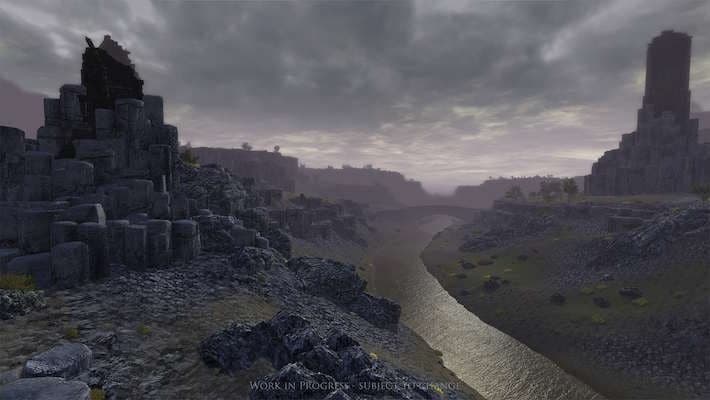
Geographically, the expansion adds three zones. Heledhris, the story's starting point, is a craggy volcanic landscape of dark beauty. Parth Rhavas shares that volcanic terrain scarred by Sauron's dominion. And Nan Ogol is the most peculiar: a "land out of time," a prehistoric volcanic jungle with experimental creatures, Sauron's ancient laboratories, and unique sky effects. Along the way, players will cross paths with Easterlings, Woses, Gondorian scouts, Elves, and Dúnedain.
On the group-content side, the expansion brings one three-player instance, two six-player instances, and a raid targeted for the end of the year. It's a package that combines what an MMORPG of this scale needs —zones, story, end-game, and a raid— with two systemic bets aimed at refreshing both the social side (Neighbors) and the progression side (Survival Instinct).
Nearly two decades in, LOTRO keeps betting on reinventing itself without raising the level cap, and The Wolves of Mordor looks like its most ambitious attempt in that direction in years. We'll have to see how the two new systems land once the expansion starts rolling out this fall, but the direction —rarely-explored lore, horizontal end-game, and housing that finally looks back at you— is among the most interesting the game has proposed in a long time.
Sources
Comments
Keep reading
 Angmar and Mordor have an expiry date: LOTRO winds down its legendary worldsAug 14, 2026
 Heidel Ball 2026: Black Desert confirms the Agent class and closes its first grand saga with Edania Part 2Jul 28, 2026
 CD Projekt Red puts a year on The Witcher 4: 2028Aug 25, 2026
 Black Desert Online raises the level cap to 70 and opens Inner Edania tomorrowAug 12, 2026